
English-tagged jobs in Switzerland: what the label leaves out
In a reproducible audit of 40 English-tagged Swiss workplace listings, 33 stored descriptions were written in English. Eight of those 33 explicitly required German. A source language tag alone does not establish the advert's written language or an applicant's language eligibility.
What we checked
We started with Panta’s 4 November 2026 inventory. Among fresh-source-backed listings with physical Swiss workplace evidence, 836 records from 49 employers had an English language tag after normalizing variants such as en_US and en_GB.
We selected one listing per employer using a declared hash ordering, then retained the first 40 employers. This creates a reproducible, employer-diverse audit. It does not reproduce the distribution of all 836 records, and it is not a representative sample of English-speaking opportunities across Switzerland.
One AI-assisted reviewer read each selected stored description and title. The review distinguished the written language from statements about German. This was not independent human double coding, and the interpretation of individual adverts can be challenged. The public audit pack includes the record identities, original source links, paraphrased notes and content hashes.
The tag and the written language differed
| Written language in the reviewed stored description | Records |
|---|---|
| English | 33 |
| German | 5 |
| French | 1 |
| Description unavailable | 1 |
| Total English-tagged records reviewed | 40 |
Six of the 39 available descriptions were written in a language other than English despite the tag. The field can come from an ATS locale or feed setting. Its name does not guarantee that someone has checked the language of the job text.
For an applicant, the consequence is practical: an “English” filter based on this metadata can return an advert that needs translating before its requirements can even be assessed. Conversely, a German-written advert is not proof that fluent German is essential for the role. Read the actual wording.
English-written did not mean German-free
We then examined the 33 English-written descriptions separately.
| Statement about German | English-written records |
|---|---|
| Explicitly required | 8 |
| Preferred or helpful | 4 |
| Ambiguous | 1 |
| No German statement detected in the stored text | 20 |
| Total | 33 |
The eight required cases included wording asking for fluency in both German and English or naming German as a candidate requirement. The four preferred cases used softer wording, such as an advantage or a helpful additional language. We kept those groups distinct.
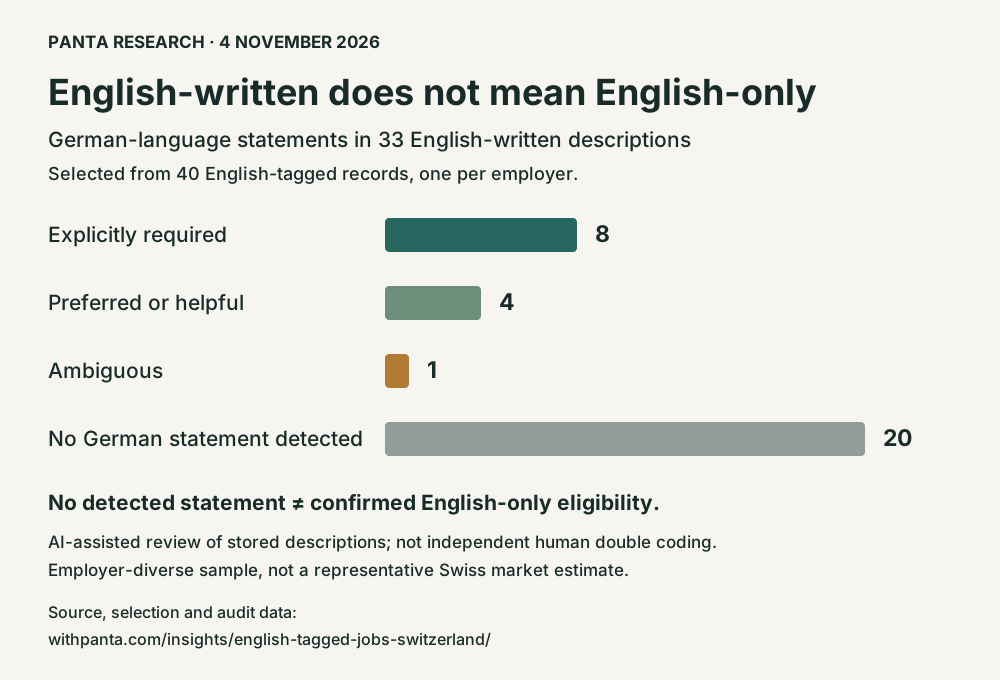
Download the chart (SVG). Its date, denominator and review limits are part of the figure; retain them when citing it. See the citation guidance and the audit pack below for the full method.
In the ambiguous case, the title emphasized German-speaking applicants while the description used softer wording. We did not force the conflict into “required” or “optional.” Across all 40 reviewed records, including the non-English descriptions, the corresponding counts were 11 required, four preferred, one ambiguous, 23 without a detected statement and one unavailable.
No detected German statement is not an English-only eligibility finding. Other languages can be required. A stored description can be incomplete: one selected record contained only a short qualification excerpt. Language may also be discussed later in an application process. This audit does not measure residence, work permits, professional recognition or whether an employer would accept a particular applicant.
Use the finding in a job search
Treat an English-written advert as a lead to read, then distinguish essential requirements from preferences and alternatives. Where the language wording conflicts or is absent, keep it as an unanswered question for the employer. Do not discard an otherwise relevant role solely because a source locale is unknown.
Our English-speaking jobs guide explains how to search across channels. The language skills CV guide helps you describe your own abilities accurately. These findings support closer reading rather than a promise that a language filter determines eligibility.
Reproduce and challenge the audit
The selection rule is: fresh source backing, physical_ch, normalized language tag en; sort by SHA-256 of panta-language-audit-v1 concatenated directly with the canonical job ID; retain the first record per employer ID; take the first 40 employers. The inventory was collected in one read-only query starting at 06:48:51 UTC on 4 November 2026.
The repository’s selector and validator check the sample order, employer identities, stored-description hashes and evidence-span hashes. Those checks establish which text was reviewed; they do not prove that a semantic label is correct. The downloadable audit pack provides the aggregate and record-level review trail without republishing full employer descriptions. Original pages may change after collection.
The sample includes different contract and training arrangements, including an unpaid fellowship. It should not be described as 40 equivalent paid vacancies. Employer IDs may group several brands, and uneven source coverage affects which employers can enter the audit.
The next study should test required, preferred and alternative languages across German, French, Italian and English adverts, with independent review and measured classification errors. Until then, the useful result is narrow: the source tag, written text and workplace requirement are three different pieces of evidence. See the November baseline and research method for the wider corpus.