
How Panta researches the Swiss job market
Panta Insights studies the job adverts Panta observes. We preserve source evidence, publish dated denominators and distinguish measured findings from missing information, external research and hypotheses. Our inventory is not a census of Switzerland's labour market.
What our reports measure
A snapshot counts observed listings at a stated collection time. It is a stock of indexed opportunities, which may include training placements and unpaid opportunities. It does not count new hires, completed applications, unique positions within an advert or every vacancy in Switzerland. Panta operates the index it studies; this is first-party research, not an independent assessment of Panta’s market coverage.
We publish three formats: market snapshots from Panta’s observed inventory, investigations answering a specific question using inspectable evidence, and evidence reviews comparing external studies. The source of a claim should be clear from the article. A proposed future study is not a completed result.
Selection, provenance and freshness
The launch method, panta-insights-snapshot-v1, uses one read-only query to select active canonical job records with at least one active observation on a trusted, enabled source and Swiss eligibility evidence. Canonical IDs are counted once. Deduplication can still leave equivalent adverts under different IDs; these are canonical records rather than a proven count of unique hiring positions.
The main analysis further requires a fresh source check and a physical Swiss workplace classification. A source is fresh when its latest completed sync succeeded and falls within that source’s configured freshness window at collection. Unknown timestamps, failed syncs and stale sources remain distinct; a record without any fresh backing is excluded from the main analysis. Source-specific windows vary, so “fresh” does not mean checked within the last 24 hours.
Fresh backing is evidence about collection. It does not guarantee every canonical field came from the freshest observation, independently confirm the employer still accepts applications, or establish the date of original publication. Source observations retain their own identity and provenance. Research collection does not edit activity, source history or normalized posting versions.
Switzerland, location and remote work
Physical Swiss workplaces, multi-country listings explicitly including Switzerland and remote listings with Swiss eligibility evidence are separate groups. A generic remote label is insufficient to establish eligibility to work from Switzerland. Ambiguous and non-Swiss records do not enter the launch snapshot through city-name matching.
Country eligibility and work arrangement are different dimensions. A Swiss workplace record may also describe hybrid or remote work. Do not add these arrangement counts to country-evidence counts as if they were mutually exclusive categories. We do not infer personal permit or residence eligibility.
Language, roles and workload
Language metadata normalizes the primary language subtag (en_US becomes en). It can describe an ATS locale rather than the written advert. It never establishes a required language or English-only eligibility. Description-language review and required-versus-preferred-language review are separate tasks.
Role families use Panta’s published reviewed title rules, versioned in each aggregate. AI, data and pharma can overlap and do not form a complete occupation taxonomy. Employer sector is a separate property. Description buzzwords alone do not qualify a role for these title collections.
Workload evidence, panta-insights-analysis-v1, scans titles and structured employment text for explicit percentage values and dash ranges. A valid dash range with a minimum below 100 produces a below-100 signal. Multiple signals including standalone 100 and below-100 values stay ambiguous; this includes some ranges written with words. No match means no percentage detected in these fields; it does not mean full-time or that the original advert omitted workload. Descriptions are not scanned. These lexical signals need contextual validation before estimating actual workload availability.
Entry labels apply ordered multilingual lexical rules to titles and employment text: trial apprenticeships, apprenticeships, internships, junior/graduate/trainee, then no detected label. This exploratory label inventory does not establish seniority, permanence or required years of experience. No detected label never becomes “senior.” Mixed or unusual wording needs review.
Study-specific experience and 80% definitions
The junior experience investigation uses a separately versioned explicit-title frame and reviews each selected record. Regular roles, structured programmes, mixed seniority, location conflicts, probable duplicates and spontaneous-application pools remain distinct. Required positive years, unquantified occupational experience, practical capability, preferred experience and explicit alternatives are separate labels. A requirement for experience does not automatically mean prior paid employment or post-qualification tenure. Conflicting numerical clauses are disclosed rather than reduced to a confident minimum. Contract permanence requires explicit evidence; full-time is a workload label.
The 80% careers investigation uses its own workload parser and frozen title-group rules. Exact 80%, continuous ranges containing 80%, discrete alternatives, exclusions, conflicts and unknown values are separate outcomes. The main estimator uses titles and employment fields; description-only wording is examined separately in review. Training labels are excluded from career comparisons. Broad career groups and leadership-title signals are exploratory classifications, with employer support and concentration checks. They do not establish actual management responsibilities, agreed schedules or promotion outcomes. The older baseline’s analysis and counts remain unchanged.
Both public study packs contain the frozen-input hash, method version and aggregate tables, plus the safe review trail described in each article. Review is AI-assisted and does not constitute independent human coding. Samples used to refine a rule are regression/review evidence, not a held-out estimate of general classifier accuracy.
Missing information and concentration
The specialist data and AI snapshot has a different collection design: paginated public API queries over its stated interval, with overlapping role-family definitions and source-backed canton filters. Its translated pages and dated download retain that independent capture. Do not combine its counts with the atomic inventory, or add overlapping role rows to estimate distinct jobs.
Every finding needs a numerator, denominator, collection cutoff and classification definition. Unknown or conflicting values remain visible. A missing structured salary field does not establish that salary is absent from the original description; the same rule applies to languages, workload and location details.
Employer and source coverage is uneven. We disclose employer concentration and, where useful, a result excluding the largest recorded employer group. That sensitivity check does not correct every coverage bias or turn the inventory into a representative survey. Location evidence is also imperfect: a source can associate a Swiss location with an internationally advertised role. We use the stored classification and do not independently verify every workplace in the snapshot. Small research-audit samples are labelled as bounded audits, with their selection rules and review limitations.
Posted pay and remote-work clarity
The salary investigation screens explicit numeric compensation signals in titles, salary fields and advert descriptions, then reviews selected evidence semantically. Pay for the advertised role, total compensation, task fees, indicative earnings, benefits and business amounts require different decisions. A bounded negative audit checks potential screening omissions; it does not establish population recall or the national proportion of employers publishing pay. Platform-added estimates and employer-origin pay are separate information products.
The remote-work investigation compares stored workplace labels with selected advert wording. Fully remote work, conditional home-office options, quantified hybrid arrangements, a field-work home base, non-workplace uses of “remote” or “hybrid”, missing descriptions and foreign-location conflicts remain distinct. The review does not convert silence into an on-site requirement or a general home-office benefit into permission to work from any country. Sample strata have different selection rules and must not be pooled into a population prevalence estimate.
Both studies retain input hashes, reproducible selection and safe evidence trails. Independent agent checks can improve coding but do not replace independent human validation. The articles state their actual reviewed populations and any remaining uncertainty.
Reproducing a snapshot
The launch aggregate JSON records the input SHA-256, query hash, eligibility-predicate hash, collection interval and analysis version. Its CSV companion gives the main count tables. Aggregates contain no candidate data or full employer descriptions.
Collection and analysis code is versioned alongside the site. Collection requires authorized read access to the public-market database. Raw research inputs stay outside the published site and repository; the collector never accesses candidate workspaces. The database receipt confirms zero rows written. Re-running the analysis on the same retained input reproduces the aggregates; collecting again later observes a different inventory. Public readers can inspect the aggregate tables and sample review trail, but cannot independently recompute the whole private input corpus from these downloads.
The separate language audit pack records the deterministic sample, review decisions, original links and content hashes. One AI-assisted reader performed the launch review. Hash validation identifies the reviewed content; semantic labels still require judgment and can contain errors. We do not claim independent human validation.
Comparing months responsibly
First-seen means when Panta observed a record, not when the employer first advertised it. New sources can create apparent growth, and unavailable sources can create apparent decline. A single missing or empty collection must not establish that a vacancy closed.
The planned monthly series therefore needs a declared source/employer panel, refresh continuity and a separate account of coverage changes. Genuine zero-vacancy employers must stay in a comparable panel when collection succeeded. Added sources must not silently enter an earlier denominator. The 4 November launch is a baseline, with no reconstructed month-on-month growth claim.
Observed advert trends cannot by themselves establish an AI effect. That question needs a research design addressing other economic changes, occupation mix and the timing of adoption. Official unemployment, survey vacancy estimates, registered vacancies and Panta listings have different populations; we reference them separately.
Corrections and use
Each report retains its dated edition. Material corrections should explain what changed and update the article’s modification date; later index changes alone do not rewrite an old snapshot. Use the correction link beside a report to challenge a count or interpretation.
You may cite our findings with the report title, date, population and link. Original employer content remains subject to its publisher’s rights; a link or an aggregate download does not grant rights to republish that content. We welcome reuse that preserves the scope and uncertainty alongside the number.
For writers, advisers and data users
Start with the investigation that answers your question. These findings use different selection rules: their denominators cannot be combined or multiplied to estimate a person’s chances of finding a suitable job. All five refer to the 4 November 2026 snapshot, not today’s vacancies.
| Question | Finding you can check | Report and evidence |
|---|---|---|
| Does an English label mean English-only work? | Of 40 English-tagged records from 40 employers, 33 stored descriptions were English-written. Eight of those 33 explicitly required German. The sample was employer-diverse, not nationally representative. | Language report · Audit JSON · Chart (SVG) |
| Does a junior title mean no experience is required? | Nine of 54 assessable ordinary-role records specified consistent positive experience years; two others contained conflicting numerical clauses. This bounded title cohort excludes several training and other pathways. | Junior report · Data and review trail · Tables (CSV) |
| Does an 80% signal mean an exact 80% position? | Of 3,365 records with an unconflicted 80%-compatible percentage signal, 170 stated exactly 80% and 3,195 gave ranges containing 80%. These are title/field signals, not agreed schedules. | 80% report · Data and review trail · Tables (CSV) |
| Does missing salary metadata mean the advert has no pay information? | At least 230 records contained reviewed numerical remuneration evidence, while only three had populated salary fields. The evidence includes training remuneration, total compensation and a task fee; it is not a national disclosure rate. | Salary report · Data and review trail · Tables (CSV) |
| Does a remote tag settle the working arrangement? | Reviewing all 50 remote-tagged records in the stored physical-Swiss cohort found 25 homeworking/hybrid options and 12 field/customer-site cases. Fully remote wording and contrary foreign-location evidence remain separate classifications in the report. | Remote report · Data and review trail · Tables (CSV) |
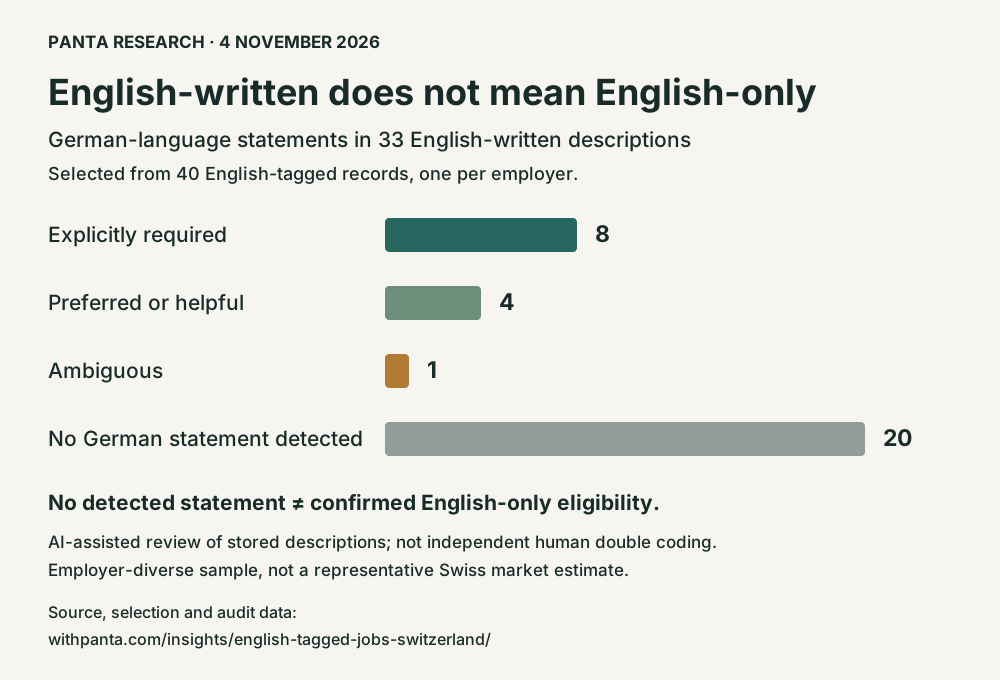
For example: Panta, “English-tagged jobs in Switzerland: what the label leaves out,” 4 November 2026, employer-diverse audit of 40 English-tagged records; German requirements assessed separately among 33 English-written descriptions. Link to the report, which supplies the selection method, limitations and original sources. Cite an external study directly when a Panta evidence review discusses that study’s results.
Keep the collection date, denominator and limitation with a reused number or chart. The downloadable chart includes them in the image. Public downloads contain aggregates or bounded review trails, not the complete underlying employer-text corpus. No open-data licence for third-party advert text is implied. For corrections or a reuse question, use the report’s correction link.
For a practical session with a jobseeker or an AI tool, use the Swiss job-shortlist review worksheet. It records evidence and unanswered questions without turning a search result into a claim that a person qualifies.